1.) Grid Interactive Systems
Grid interactive comprises of battery and solar connected to an inverter which is bi directional.
Bi-directional inverters gives you continuity of power to connected loads even in times of power outages, and will send excess power generated by
the solar panels to either the grid, batteries or load.
All our systems are modular in design and can be upgraded at any stage.
One can start with a small system and upgrade to grid independence.
We use a variety of inverters depending on application and requirement.
We work with large international companies operating in South Africa.
They have a full complement of engineers should one have any technical issues they can be addressed on a local level.
These companies also give full back-up regarding warrantee and have repair centre’s in South Africa.
All the inverters and products are robust and designed to handle loads in excess of specification.
All Grid interactive inverters can be connected in series or parallel allowing 3-phase power or enlarging the system at any stage.
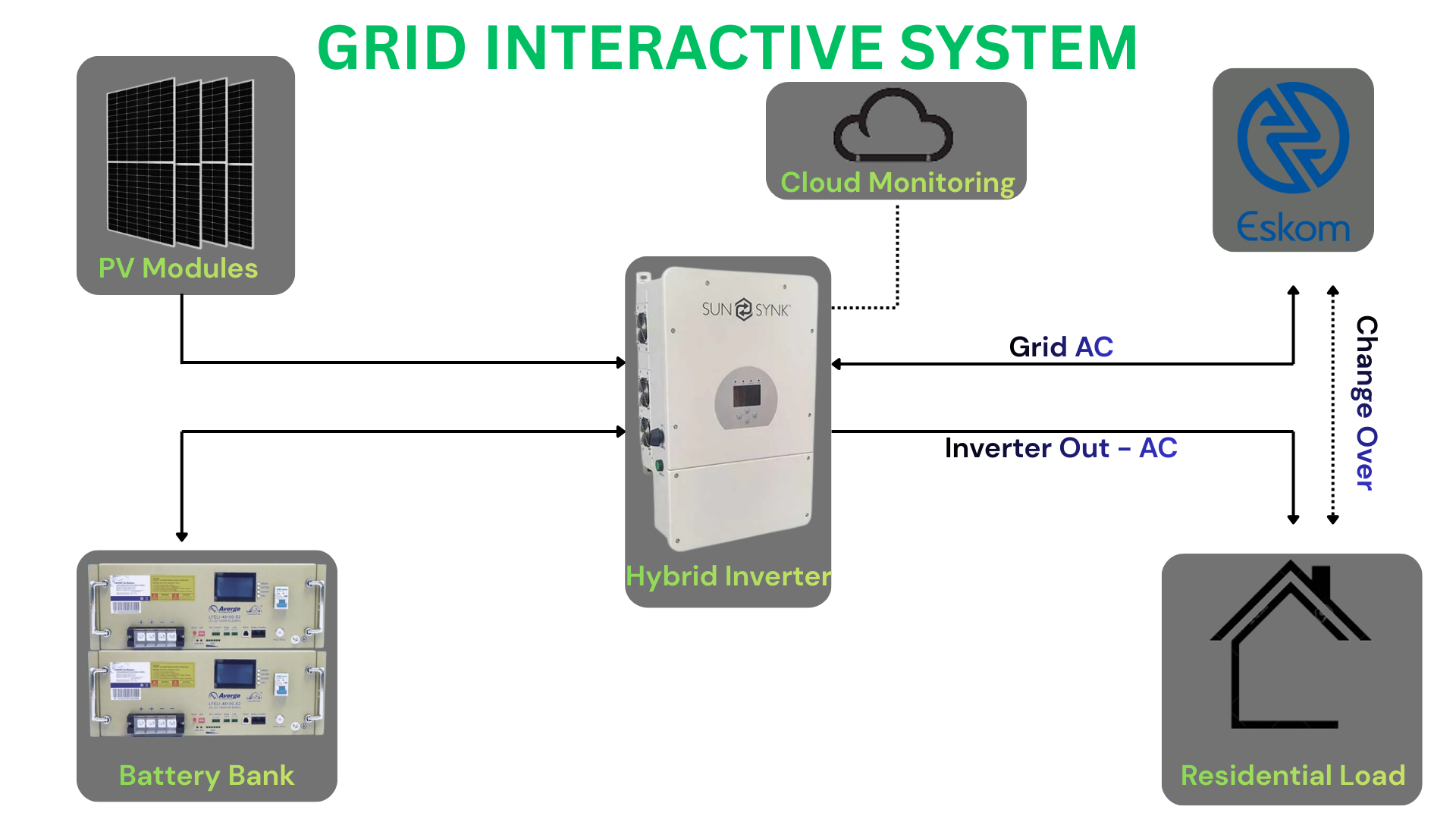
A typical installation would be as per layout below:
2.) Grid Tie Systems
Grid tie system’s comprises of solar panels and inverter only, there are no batteries and no back-up power.
Grid tie systems are connected to existing utility and supplies power to the connected load reducing the electrical usage.
This is the most affordable system to install in solar power generation.
Grid tie systems are modular and can be upgraded at any stage.
Inverters range from 3kw to 150kw in single and 3 phase and can be connected in series to enlarge systems.
They can also be connected in conjunction with grid interactive inverters allowing system to be self-sufficient.
These inverters can be AC coupled to allow for a battery system at a latter stage.
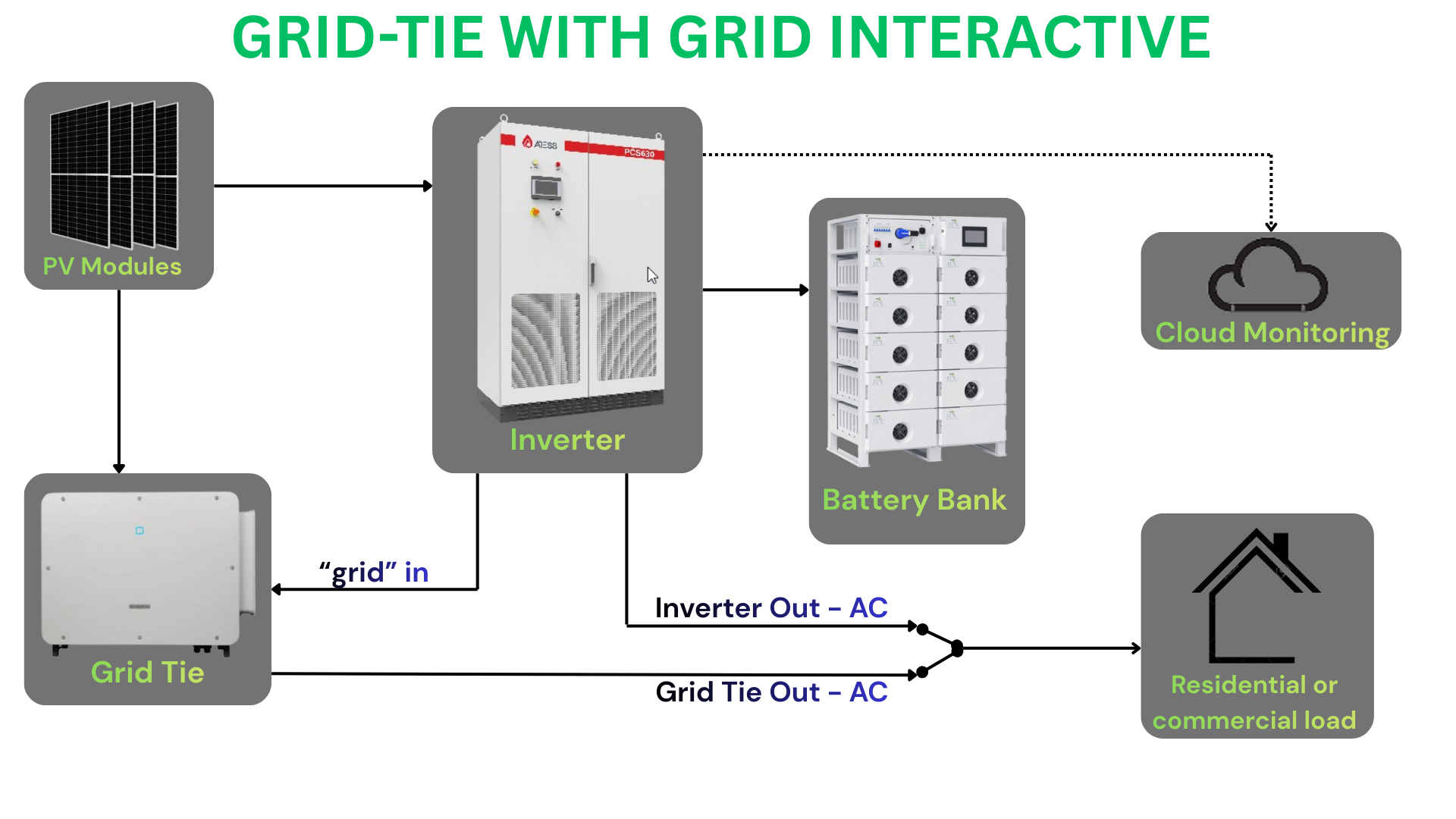
Below is a typical layout of grid tie system and grid interactive with grid tie layout:
3.) Island Systems
Island systems are installed where there is no electricity supply and total power consumed is generated by alternative means.
All island systems will have batteries to store power for 24 hours use.
There are many different permutations in island systems design and the best systems are normally hybrid in configuration.
They can consist of solar, wind power with hydro and generator as a back-up.
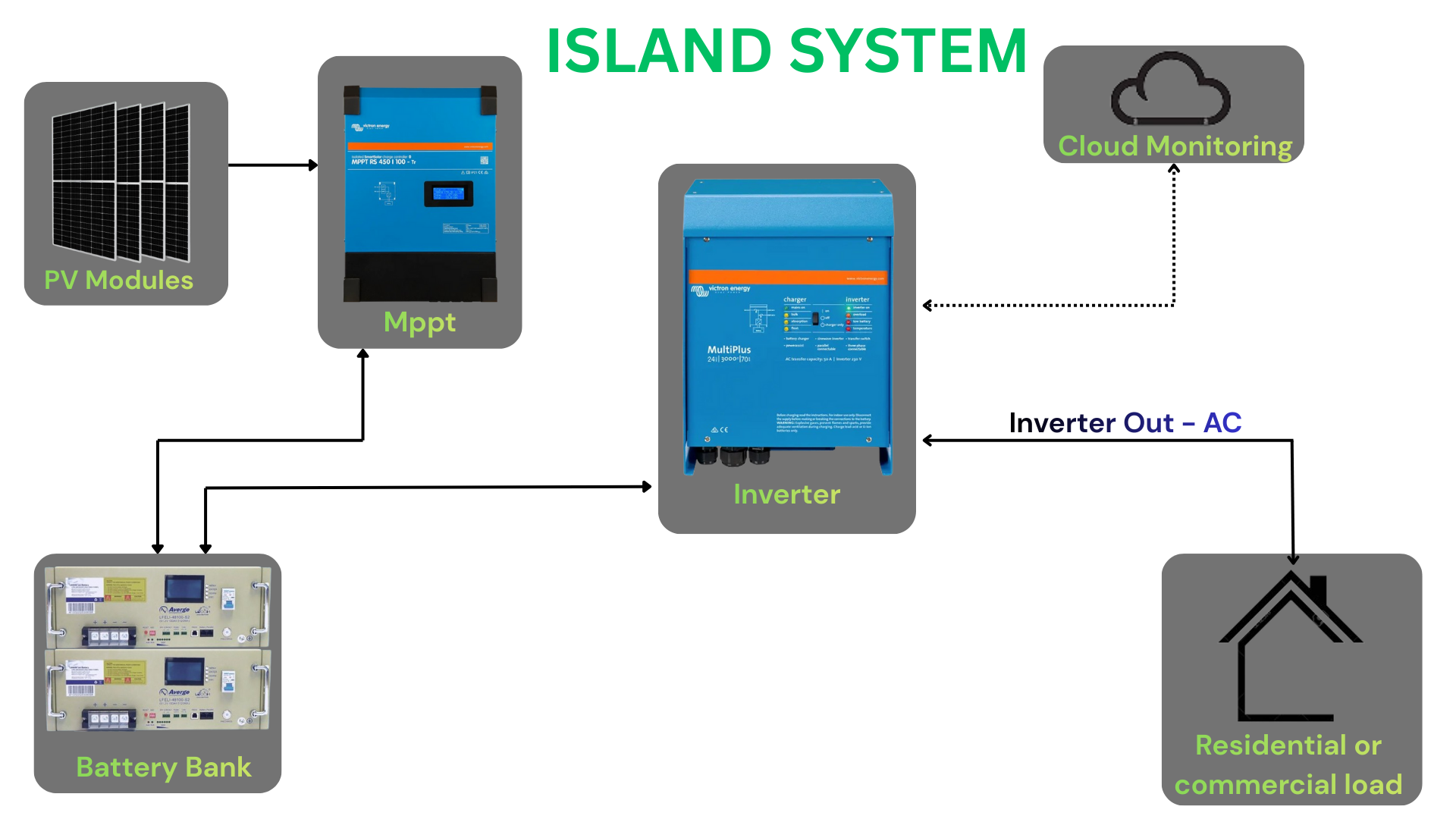
Below is a typical layout of an island system: